Saturdays with Charles Bronson 21/04/18

 / LEAVE A COMMENT

Saturdays with Charles Bronson 21/04/18

 / LEAVE A COMMENT7607c0fdbd862574c82c90d22ee21106

Two hard men of Hollywood.

(i)

Popular mechanical Brisbane poet Liam Ferney, not content with the status quo, has upped his career options and established a new four month boom poetry readings series in Brisbane called, “Saturdays with…” and the first event “Saturdays with Charles Bronson” took place yesterday at the Can You Keep a Secret bar on Stanley Street, Woolloongabba. The bar is decked out like your aunt’s and uncle’s kitsch home from the seventies, lots of wooden cat statues, cane chairs, African-styled figurative floor lamps, macramé tapestries, mid-century ceramics, but most importantly, it has an impressive black painted bar.

Walking through the entrance was akin to slamming open those wild west saloon doors, (something Bronson was attuned to do in epics like The Magnificent Seven and Once Upon a Time in the West) where the protagonist is met with silence and squint-eyed suspicion. This was my first gig back in Brisbane since the notorious ‘securityguardgate’ of last year, but there were at least a few friendly poetry pilgrims – Nathan Shepherdson, Damen O’Brien, Stuart Cooke, Brentley Fraser and Duncan Hose (who hopefully is becoming a local sheriff) and no Queensland Protective Services lawmen in sight.

Liam introduced his new reading series by acknowledging Woolloongabba’s rich poetic history and its galvanizing effect on him as a younger poet. He remembered reading at Melissa Ashley’s and Lidija Cvetkovic’s poetry event, “New and Selected” in the late nineties and even mentioned the ancient poetry reading, “Chalice Poets” from the early nineties where I first met legendary Brisbane poets like Brentley Fraser and Rebecca Edwards. The old building where they both were housed has now made way for the expanse of the Lady Cilento Children’s Hospital. So hopefully enough poetry vibes still remain in that place to help with the littleuns’ healing.

The timing of Liam’s new gig couldn’t be better. Regular readings like ‘speedpoets’ seem to have faltered for the time being in Brisbane, and if you hate slam poetry as much as I do then it’s pretty thin on the ground for page poets in this ‘anonymous’ city that could be any city in the world according to our film bureaucrats who try to sell it to the international market. As for funded events like ‘Couplet’ and the ‘Riverbend Poetry Series’ controlled by the QPF, well you’re either in with the ‘in’ crowd or you’re not. You are me. Therefore, ‘Saturdays with…” is a pure page poetry gig, that unashamedly programs poets based primarily on their quality, track record and publications. The thing is, Queensland has a burgeoning plethora of young, new, emerging and even some established poets who have new books out with interstate poetry publishers, particularly it seems with Vagabond Press. Three of this month’s readers – Anna Jacobson, Angela Gardner and Stuart Cooke all have books published by this press, and I believe Pascalle Burton has a forthcoming title from Cordite Books, About the Author is Dead to be released in June. Then there’s some fabulous emerging poets like Shastra Deo, Chloe Callistemon, Rae White, Vanessa Page, Carmen Leigh Keates and Zenobia Frost. So Liam has his work cut out for him only having space to program 16 poets in the first year of his new event.

Thus, four poets read their own work, plus were invited to read/respond to two poems by poets they like. So we not only were privileged to hear old and new works from Stuart Cooke, Angela Gardner, Damen O’Brien and Anna Jacobson, but the audience also heard poems from Seamus Heaney, Kate Lilly, Marianne Moore, Fay Zwicky, Anne Sexton and Andrew Marvel.  First up was Damen O’Brien, whose name you’ll find on the lists of many poetry prizes around the country. His poem ‘Fruit-picking’ was a fine imagistic response to Heaney’s ‘Digging’ that he read out as a favourite. Next, Anna Jacobson, read for the first time from her new poetry collection, The Last Postman (Vagabond Press – deciBels Series 3) and it felt like being in a flowing, transcendent Jim Jarmusch film – Night on Earth maybe. I bought a copy for $15, again very happy to support Queensland poets at the ground level. Angela Gardner and Stuart Cooke are both frighteningly accomplished poets  – Opera is Cooke’s latest collection from Five Islands Press and he read the title poem ‘Opera’ too, brilliant work and I admit, it’s a book that I need to get my hands on immediately.

(ii)

Famously, it is reported that Charles Bronson wanted to punch out Lee Marvin’s lights on the set of the WW2 film, The Dirty Dozen (1967) directed by Robert Aldrich. Marvin’s drinking was upsetting the production flow and Bronson was no longer going to stand for it. You can kind of forgive Marvin though; he was a WW2 Marine veteran of the Pacific theatre and was twice wounded in action in the Battle of Saipan, shot in the back by machine gun fire and in the foot by a sniper. Making all those violent crime, western and war movies afterwards probably triggered a few flashbacks now and then on set. Bronson had the gonads to threaten Marvin like this, as he was also a WW2 Pacific theatre veteran, having flown 25 missions as an aerial gunner on a B29 Superfortress bomber out of Guam, the same type of heavy bomber that later dropped the two atomic weapons on Japan.

There is a cool poetic moment in The Dirty Dozen, when Marvin, the commander in charge of recruiting and training these twelve death row American soldiers for a suicide mission deep inside Germany to assassinate some Nazis top brass, requires them to learn the final mission details off by heart through reciting a poem.

  1. Down to the road block, we’ve just begun.
  2. The guards are through.
  3. The Major’s men are on a spree.
  4. Major and Wladislaw go through the door.
  5. Pinkley stays out in the drive.
  6. The Major gives the rope a fix.
  7. Wladislaw throws the hook to heaven.
  8. Jiminez has got a date.
  9. The other guys go up the line.
  10. Sawyer and Gilpen are in the pen.
  11. Posey guards Points Five and Seven.
  12. Wladislaw and the Major go down to delve.
  13. Franko goes up without being seen.
  14. Zero Hour: Jimenez cuts the cable; Franko cuts the phone.
  15. Franko goes in where the others have been.
  16. We all come out like it’s Halloween.

Presently, I’ve found myself writing a bit more poetry about war courtesy of the ‘War History Online’ posts on Facebook. Many strange, tragic and terrible stories appear everyday through this feed (even the story about Bronson wanting to hit Marvin) and I am naturally drawn to those tales that seem quite unbelievable. A recent story concerned Mariya Oktyabrskaya, a Russian woman, who after her husband was killed by the Germans in the Battle of Stalingrad, was so angry that she wrote to Stalin personally and begged him to allow her to buy a tank, so that she could fight the Germans herself and take revenge.

Now you’d think that with all of the millions upon millions of pieces of correspondence and files generated by an event such as the German invasion of Russia, that Stalin would have had little time to respond to her request, being buried under the mountains of papers, reports and decisions that he would have had to deal with every day, particularly around 1941-42. But he did respond to her letter, moved by her patriotism towards the Motherland and her loss and granted Mariya her request. So, undaunted she sold all of her belongings, took what cash she had out of the bank and raised enough capital to purchase a brand spanking new T-34 medium tank right off the assembly line. She named it ‘Fighting Girlfriend’.

She trained and became the tank’s driver, was given a crew and put into a tank unit on the Eastern front. At first the men in her tank platoon thought that she was nothing more than a sad joke; a propaganda stunt devised by Stalin and that she wouldn’t really fight the Germans; just be driven around waving at the real troops. But they were wrong. Mariya saw action maybe three times. Twice her tank was hit by artillery fire and its tracks disabled. Twice she climbed out of her tank under intense shellfire and attempted to fix the problem, much to the astonishment of her crew. Her second attempt was her last, as she was hit by a piece of shrapnel and critically wounded. She fell into a coma and later died, joining her husband at last in a sacrifice worthy of a Brooke sonnet. Stalin even gave her a medal. My poem “Fighting Girlfriend” was recently published in Issue 3 of StylusLit at http://styluslit.com/poetry/fighting-girlfriend/

Next month’s gig is “Saturdays with Rosalind Russell” and features two Arts Queensland Thomas Shapcott Poetry Prize recipients – Shastra Deo, (2016 ) and Rae White (2017), as well as newcomers Ella Jeffrey and Jake Goetz. I’ll be reading about Mariya and other heroes both on and off the screen at the June gig. Hats off to Liam Ferney for breaking me out of my poetic military prison. It’s been two years since I’ve been a featured reader in Brisbane; five years since I’ve read in Melbourne, eight years since I’ve read in Sydney, and I think nine years since I’ve read in Adelaide. Perth, Darwin, Canberra…ah not yet I’m afraid. One day perhaps… when I receive that wonderful suicide mission.

2024 Queensland Writers’ Fellowship

On Wednesday the 6th September I received a 2024 Queensland Writers’ Fellowship from Arts Queensland, and the State Library of Queensland to write my next collection of poetry “The Eromanga Sea”. The name comes from the Eromanga Sea, a shallow inland ocean that occupied large parts of Queensland in the Lower Cretaceous Period around 110 million years ago. These linked-narrative poems will be in 4 sections (The Lower Cretaceous, The Pleistocene, The Anthropocene and Torresia & Cooksland). The Eromanga Sea will explore Queensland’s geological, ecological and socio-cultural evolution as a ‘state’ from the Cretaceous period through to the current Holocene epoch, looking at the major climatic and human impacts in these ages and how deep time and human activity has shaped not only Queensland’s physical landscape, but also the consciousness of the people who live here. 


The Eromanga Sea.


Cretaceous Period 110 million years ago.

“Critical State” reading and book launch

Collective email: calanthecollective@gmail.comPress email: calanthepress@gmail.comWeb: www.calanthepress.com.auFacebook: www.facebook.com/groups/calanthecollectivepoetry
Dear Members and Supporters,
What an extraordinary time we’ve had this last weekend.

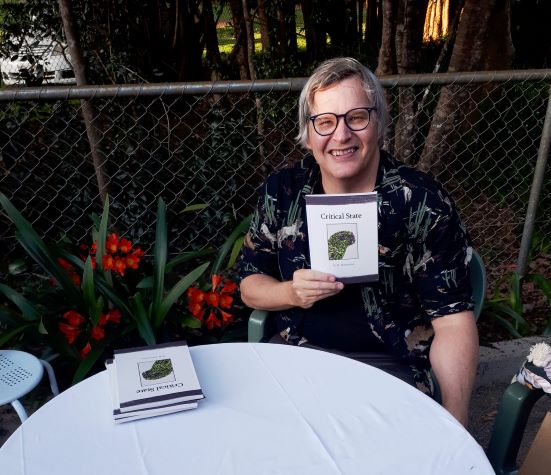
On Friday evening at the Zamia Theatre in Main St, Calanthe’s guest poet, B.R. (Brett) Dionysius, read from his latest work, the Calanthe Press published Critical State.
Brett is a fine reader of his own work and his introductions to the poems he read were witty, informative and presaged the sadnesses, the regret but always the hope that his poems, speaking of habitat loss and species extinction in Queensland, so evocatively articulate.  Not only are they a lament and an admonition for the sins of omission and commission against Queensland’s natural worlds, they are a valuable, nay, important historical reckoning for carelessness and dismissal of the concerns of native fauna and flora and ignorance of their interdependence.

It’s a map of Queensland and an encyclopaedia and a volume of some of the most fascinating and evocative poetry you’ll ever have the pleasure of reading. I can see its being a text to be studied and treasured by English literature students, by history students, by environmental science students, by biology students and by the average Joe Blow who just loves to know stuff. 

Critical State was officially launched on Saturday afternoon at Under the Greenwood Tree Bookshop and Artspace with a speech by Vanessa Page, a Calanthe guest poet and author of Botanical Skin, one of Calanthe Press’s publications of 2021. Like Brett’s poetry, Vanessa’s speech was a thing of beauty, extolling the wonders of Brett’s poems. So impressed were we by her careful study of Critical State and the way she spoke to and of its heart that we asked her if we could post it on the Calanthe Press website. That’s imminent and we’ll let you know when it’s up.

May I say from a personal reading, I love BR Dionysius’ Critical State. I’ve bought several copies to send to poetry loving friends and family. And a pollie or two. Truly, it is a work of great beauty and would be a fine addition to anyone’s library. 
Why not check out our website (www.calanthepress.com.au) where Brett’s Critical State and the other Calanthe Press publications can be purchased. Christmas is on its way. Consider a gift of poetry this year…oh, every year.

And a final treat for 2022 is on the 25th November, Poets@Yuulong with guest poet Steve Stockwell. Keep that in your diary and look out for the details coming very soon. 
And give us a yell if you’ve any concerns or just have something to share.

Geoff Cartwright

Secretary.

Calanthe Collective secretary Geoff Cartwright and the author.

“Critical State” book launch speech by Vanessa Page 24/09/22

B.R. Dionysius launches his ninth poetry collection – “Critical State”

A Critical State

I’d like to first acknowledge the Traditional Owners of the lands on which we gather here today for this happy event. The Wangerriburra clan of the Yugambeh peoples.

I’d like to welcome you here this afternoon to the launch of Critical State, a stunning new collection of poems from B. R Dionysius. I have known Brett for more than a decade and was honoured to be asked to speak about Critical State today.   

Brett is one of Queensland’s most accomplished poets and in this, his fifth full book of poems, we are witnessing a poet at his full power and writing the poems that he was perhaps always meant to write.

This is an important book. And it’s a coup for Calanthe Press.

Queensland poetry matters, and the work that Calanthe Press does in showcasing local voices matters. Having stood in this place just over a year ago myself, today’s launch feels almost like a homecoming.

And this book too, feels like home.

In Critical State, Brett’s home state, Queensland is dissected, examined and laid bare.

The mapping of our places and stories feels more important than ever.

Indeed, it feels more critical than ever that Queensland voices are heard.

It feels more critical than ever that our truths are transcribed, spoken and preserved.

It feels more critical than ever that we are honest about who we are, what we have become and what price we have paid along the way.

Brett’s voice is unique and it is uniquely Queensland.

In launching Brett’s Weranga back in 2013 I made comment about its wonderful vignettes of rural Queensland life that could be savoured in the moment and upon re-reading. 

In Critical State we find this, and more.

Our state is a quandary – full of contradictions.

It’s baffling, brutal and breathtaking. It’s both fascinating and terrifying.

You will feel all of these things, and more, in Critical State.

This book cleverly maps the ecology of Queensland, from top to tip. But beware, this is not simply a collection of beautiful ecological poems to enjoy with a cup of tea in an afternoon.

You’ll find exceptional beauty in them, but they are poems that will demand more of you. This is a collection of truths, many of them uncomfortable.

This is a book that will cause you to feel and force you to look.

Arranged geographically into five regional sections, Critical State is a culmination of works spanning 2010 to 2021. Prose poems on topical subjects abound and throughout, the underlying theme of resilience and defiance in the face of extinction.

Brett has a masterful ability to write narratives and re-examine histories and, in this book, he layers this with his great passion for ecology, especially birdlife.

This is a tour of Queensland brought to life and with deep engagement with place.

Brett pulls back the rainforest curtains, he lifts up the sticky carpet in a mining town pub, he encourages us into silence and stillness as we observe the interplay between human interventions and the wild.

He shows us the truth that lingers in these places, and more.

You will find moments that delight and abhor you in equal measure in Critical State. It’s a lengthy book – and I have many personal highlights – far too many for a book launch speech.

Critical State opens with poems of the untameable north. In the Wet Tropics, you’ll find sprawling poems that unlock the region’s secrets.

Poems about the degradation of place and of people – interspersed with poems about endangered species.

Poems that pulsate with the sensations of the far north.

In the apocalyptic tale of the Palm Cockatoo the deep north is captured in all of its laconic, watchful glory.

The bird, “tracked through sound, nuts cracking claw to mouth as it ate – and you watched each other for a red hour.”

In Lockhart River – you’re drawn into a landscape where everything is out of place.

In a remote place that should feel unspoiled, the poet finds himself tripping over the detritus of human activity, eerily described in a way that makes you feel like something might happen at any moment.

In Peninsula Development Road, we understand the power in the landscapes of the north and the weakness in what the development-locked south has become.

Two poems flare particularly brightly.

In Unicorns Cross Here, the far north is compelling in its order and chaos: wild, dangerous and unpredictable. Captivating images abound:

  • Box jellyfish hanging like toolies
  • Birds the colour of a tiramisu cake
  • Microbats huddling together like a Scotsman’s sporran or a witch’s pouch bulging with fangs and wings.
  • Rainbow lorikeets speaking a language of smashed stones.

But it’s the disturbing description in crocodile paranoia that echoes long after the reading.

A visceral and terrifying sequence as the poet skilfully draws you deeper and deeper into a breathless, uncontrolled moment.

I read poetry for moments just like this.

Critical State is a commentary on us and the places we inhabit and impact, as well as the living things that were here first.

The contrasts of extinction and proliferation are captured perfectly in poems about the cane toad and the cassowary.

The section rounds out with The Wet Tropics – the poem for which the section is named.

In this sprawling poem, we learn more about the poet’s passion for birdwatching. In this work we are brought close to the action by the poet, who invites us to share in his discovery.

“This magical sensation of identifying a new species for the first time, deft as a card trick, as though evolution pulled a bouquet out of its voluminous green sleeve just to make you smile.”

In part two, The Red West, we encounter more poems of survival, defiance and retreat.

In Night Parrots, both extinction and salvation take on a human shape as we watch an ecologist go about his work with this miraculously re-discovered species. The poet musing that:

“For a hundred years, the parrot has drained out between extinction’s fist, an unstoppable slow leak.”

In the poem Spinifex, the plant’s inherent hardiness is a metaphor for the state itself, and described in the poem as being:

“emblazoned on the landscape’s drab uniform like a military patch, like courage, like bravery. Like a Victoria Cross the outback awards itself every day for surviving.”

The poet also brings us a stunning collection of sonnets in the Bimblebox Nature Reserve poems, where creatures are pitted against the mining industry machine.

In this sequence, the tussle between progress and the environment in the Central Queensland region wrestles across the pages.

These are poems of fragility and brutality, stories of the prices we all ultimately end up paying for progress and profit.

In Maureen Cooper’s Quilt, the poet observes:

“Machines dig, machines stitch too; humans applique tininess to the bigger picture. The future wins a raffle.”

And again, in this section, wonderful metaphors on every page:

  • Coal deposits forming a “fallow dragon that on awakening will fire up its hot breath.”
  • Black throated finches that “scatter to the air like a handful of wedding rice.”

In the Yakka Skink, a tale of defiance, as the tiny creature stands tall before the mining industry – declaring that we were here first and we will endure, long after you retreat from this place:

“we live in your tiny mines that went broke.”

In part three, Wide Bay, the Great Barrier Reef geographically places the reader.

In Asbestos Manor, Hervey Bay the poet paints a coastal town from another era that echoes the region’s endemic environmental sickness. Describing the bright yellow eyesore, heaving with poison as “part protest, part warning, all a mistake.”

These are familiar landscapes for Queenslanders of a certain vintage, and the wonderful Vic Hislop’s Shark Show, provides more of this kitsch cringe.

In this poem, parents walk their kids through an exhibit, that through adult eyes is far less terrifying and far more ridiculous, the prize exhibit, the refrigerated great white observed as:
“wilted like a pressed flower rediscovered after thirty years between the pages of a book.”

And so too are the memories we all carry around with us, and which display the ravages of time when we let them out to inhabit the space.

Having grown up in Toowoomba on the Darling Downs, the next section of the same name felt particularly familiar.

The opening poem Brigalow: An Extinct Pastoral opens the section and in so many ways feels like the heart of this collection.

This poem, which lunges across three pages is spectacular. The poet writes the violent death of the forest with a palpable anger and this poem feels personal.

Stanza after stanza describes the destructive industry of machine and man, likening it to the bringing down of a great Empire. For this was, and still is, a war.

You’re left feeling pain on behalf of the survivors…the images of

  • remnant forest ‘begging beside highways’…
  • and trunks twisting like the wrenched skin of a Chinese Burn…
  • and the countless bodies of endangered species that have gone missing….

Like a bereavement notice in the newspaper, species are named in a roll call of victims, closing out the poem.

Elsewhere in this section another personal highlight, My Brother Finds a Holy Cross Frog in Chinchilla.

A compelling poem about adaptation, set in a soulless FIFO camp.

That something rare and fragile can be found in such surroundings speaks to the critical themes that run through this collection.

The blindness in human intervention, the bright hope of survival and resistance.

In this poem too, a nod to legendary Chinchilla poet Jean Kent.

Critical State concludes in the South East corner, and in this section, poems continue to wrestle with the scars left by big coal and the heavy price of human impact.

This thread is brought to a flash point in the engrossing poem Black Lung.

Here, the poet describes this disease in compelling detail as it inhabits the protagonist’s body that was:

“found in a post-war modern in Bundamba, buried deep in Percy’s body like shrapnel never dug out…”

Throughout, Black Lung disease is likened to a range of natural phenomenon:

  • an electrical storm
  • a dying universe
  • a dark nebula of scarring, and
  • a wildfire burning out of control.

In Black Lung, the poet leaves the reader feeling breathless and heavy as the human impact of the mining machine hits close and takes on a human form.

In Failing to See Regent Honeyeaters at Springfield Lakes the poet takes us on an expedition based on a hot tip, as he and his daughter seek out the elusive birds in the great behemoth of the Springfield Lakes development.

In this poem, the poet cleverly balances the possibility of the birds with the artificial nature of the sprawling satellite city.

The birds “shouldn’t have been here at all. In this blighted oasis.”

And – “This wasn’t an ironbark woodland, but renovated park; polished boardwalks, swings, joggers lapping the lake, exercising their knowledge of real estate.”

I think that perhaps this will be the only poem ever written about Springfield Lakes!

The poem concludes with a sense that perhaps all has already been lost and that it is up to us now to rely on our memories and pass on our stories.

I’ve spoken about far too many poems in the book and indeed could have spoken about many more…but I will mention in closing, the final poem in the book Red Shift for Judith Wright.

I spoke earlier about the heart of the book and we find this thematic heart beating here too.

In this poem, we are reminded of how important it is for us as poets, as it was for Judith before us, and for Brett here today to tell these stories, to make noise about them, and to preserve these truths for those who’ll come after us.

And finally, a stanza from Red Shift:

“the Earth sucks in its beltline and gyrates its middle age

spread. Forests recede like hairlines thinning out, as the hand

of progress combs through them. All that’s left is hollow rage

as small groups of creatures turn and make their final stand.”

It’s my great honour to declare Critical State officially launched today!

Again, thank you to Calanthe Press and to Janene and Under the Greenwood Tree bookshop for hosting.

Please buy a copy for yourself and then a copy for your children and your grandchildren.

Our State depends on it.

Vanessa Page ready to launch “Critical State”

“Critical State” Book Launch 24th September

Dear Members and Supporters,

Last year, BR (Brett) Dionysius was our guest poet for our September pop-up poetry night. That night the heavens opened and as Brett delivered his poetry, the sky delivered vengeance. How Calanthe Collective or Brett had transgressed was beyond us but the rain gods of every culture, all sixty or so of them, (Wikipedia told me how many) sent their contemptuous, drowning and perverse but unfathomable justice. But oh, dear members and supporters, how truly fortunate were we! Brett not only writes fine poetry but is a powerful and entertaining speaker. He threw contempt back in the faces of the rain deities, and in a momentary lull, called on them to send their worst. The drama of the evening was tense but, as all David and Goliath stories end in David’s triumph, so too did Brett’s. We were privileged and enthralled to hear his fine work and thoroughly entertained.

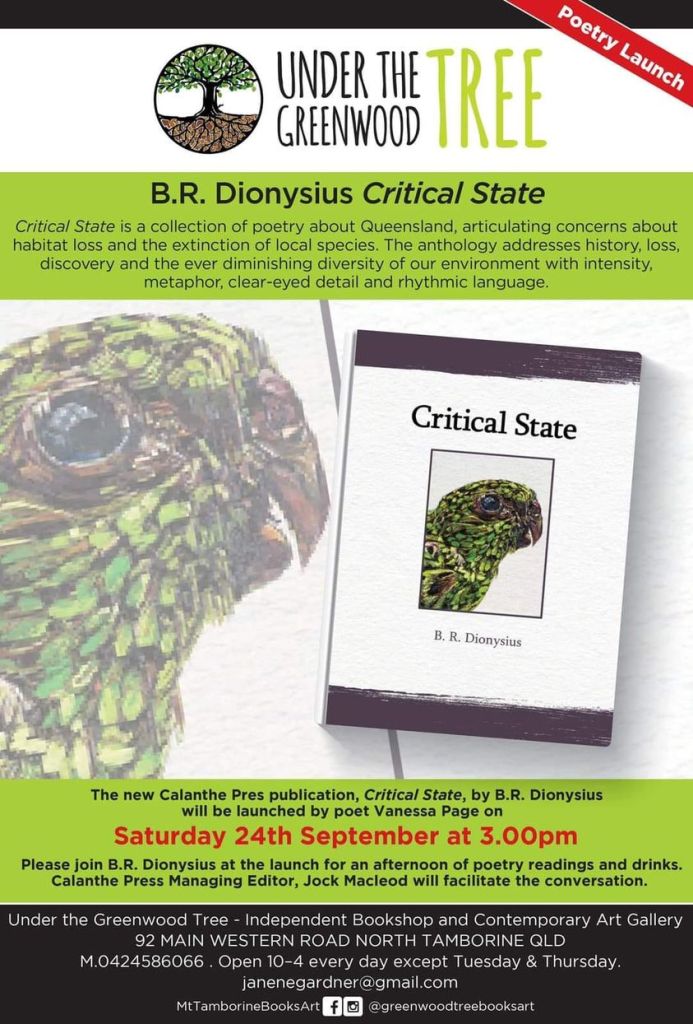
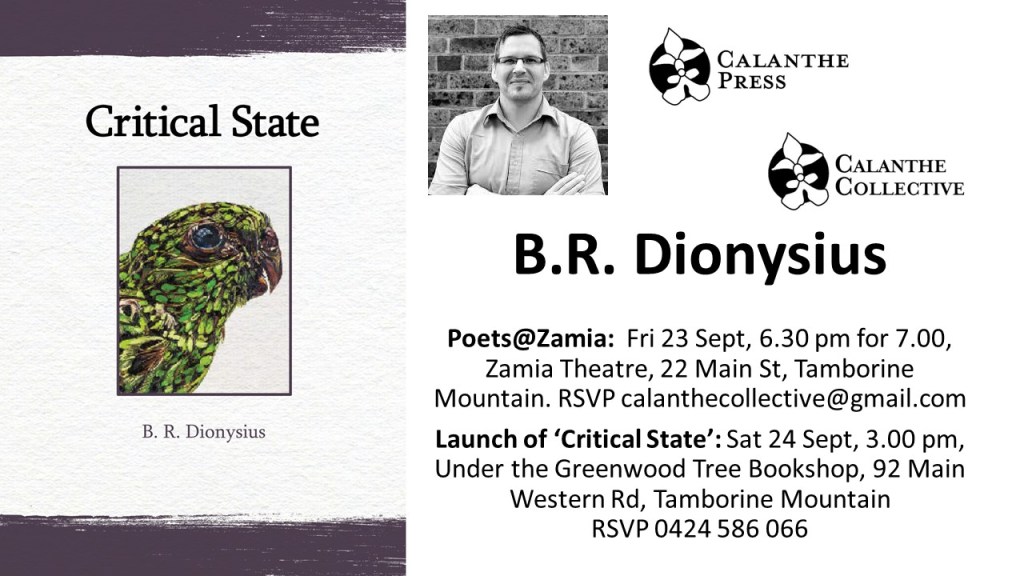
And so Brett returns to us on the 23rd and 24th of September. First to reprise his place as guest poet – this time at the Zamia Theatre – and then at Under the Greenwood Tree Bookshop and Art Gallery, to have Vanessa Page, a favourite guest poet of ours and the writer of the Calanthe Press published Botanical Skin, launch his Critical State, the latest publication from Calanthe Press. 

Both these events will be poetry delights. 

“Critical State is an evocative ‘tour’ of Queensland, engaging deeply with place, and the nature of interactions between humans and the natural world. Birds – extinct, endangered and otherwise – feature. Humans frequently do not come off well. Arresting prose poetry, timeless and deeply topical.”

B. R. Dionysius was founding Director of the Queensland Poetry Festival. His poetry has been widely published in literary journals, anthologies, newspapers and online. He is the author of one artist’s book, The Barflies’ Chorus (1995, Lyrebird Press), four poetry collections, Fatherlands (2000, Five Islands Press), Bacchanalia (2002, Interactive Press), Bowra (2013, Whitmore Press), Weranga (2013, Walleah Press), a verse novel, Universal Andalusia (2006, SOI 3) and two chapbooks, The Negativity Bin (2010, PressPress) and The Curious Noise of History (2011, Picaro Press). He won the 2009 Max Harris Poetry Award, was joint winner of the 2011 Whitmore Press Manuscript Prize and was short-listed in the 2017 Montreal International Poetry Prize. He lives in Brisbane, teaches English and in his spare time watches birds.

EVENT ONE

IS WHAT?  Guest poet B. R. Dionysius reads his poetry at our Poets@Zamia Pop-up evening

Blackboard Poets before interval. A dozen spots for anyone to read a poem of their choice – their own or someone else’s. Bung your name on the blackboard. First in first served.

Music

IS WHERE?  Zamia Theatre, 22 Main St Tamborine Mountain.

IS WHEN?  Friday 23rd September. 6.30 pm for a 7.00 PM start.

ENTRY

By donation at the door. All proceeds go to the hire of the venue and the guest poet.

People ask how much is appropriate. That depends a little on how fat your purse and inclination are.

 Donations vary between $5.00 and $20.00 generally. It’s what you can afford. 

But please don’t put off coming if you’re skint this month. Make it up at a later pop-up night.

WHAT TO BRING

Nibbles and tipple of your choice. It’s a festive affair.

A lightness of heart and an openness to enjoying yourself.

Cash or card to purchase Brett’s and Calanthe’s publications that will be on sale.

BOOKINGS

This is pretty essential so we don’t overbook. 

And note, this is a different booking address from Event Two.

Email this address: calanthecollective@gmail.com

or

Text me on 0416 217 005

EVENT TWO

IS WHAT? The launch 

of B. R. Dionysius’ Critical State, Calanthe Press’ latest publication.

Vanessa Page, a treasured 2021 guest poet of Calanthe Collective and the author of the Calanthe Press publication, Botanical Skin, will launch Brett’s work.

IS WHEN? Saturday 24th September, at 3.00 pm.
IS WHERE? Under the Greenwood Tree, Bookshop and Art Gallery92 Main Western Road, Tamborine Mountain

ENTRY Free as the birds.

WHAT TO BRING – Cash or card to purchase your copy (or copies) of Critical State.

Wine’s laid on (Thank you, Janene!) so there’s no need to bring any.

BOOKINGS – Text or phone 0424 586 066. 

That’s the number for Under the Greenwood Tree, whose proprietor is Janene Gardner

AND WHILE I’VE GOT YOUR ATTENTION

Have you been onto the Calanthe Press website yet, or haven’t visited for a while? Its address is up the top there: www.calanthepress.com.au

It’s worth a visit, as by my reckoning (and the reckoning of myriad others) it’s a cracker of a site. It’s full of information about Calanthe, its activities, past and to come, its publications which you can purchase there and biographies of their authors and details of the Calanthe Collective Poetry Prize. It’s a poetry lover’s paradise, so do yourself a poetic favour and check it out. 

We’d love to see you at one or both of these events. And if you have any further questions, queries or quibbles, write to calanthecollective@gmail.com or get in touch with me, the Secretary Geoff Cartwright on 0416 217 005.

Poets@ Yuulong

I’ll be one of the Calanthe Press poets reading on the day! Bookings are essential as this will be a reading in a Mt Tamborine private garden.

Program for 19 June – Ben and Rosie’s (or Zamia if wet)

2.05 pm – Welcome and Acknowledgement of Country

Margy to introduce Calanthe Press poets in order of publication, she will particularly note the reprint of Jena’s book and then the new reprint of Jane’s.

              Jena Woodhouse

              Anthony Lawrence

              Jane Franks

              Vanessa Page

              Stuart Cooke

              Brett Dionysius

Music – Susannah

Announcement and Presentation of Calanthe Collective Poetry Competition winners – Jock and Jena

Music – Margy

Interval/Break – Instrumental Music

Jock to introduce David Malouf

Guest Poet – David Malouf

Music – Margy or  Ludek

Poets@CRA

30th SeptemberPoets @ CRA
September seems to be barely upon us, yet here we are, touting a treat for its last day. 
Set this evening aside, Thursday 30th. Calanthe Collective and Smallroom Collective present:
An evening with Brett Dionysius.

Brett Dionysius publicity.jpg

B. R. Dionysius was founding Director of the Queensland Poetry Festival. His poetry has been widely published in literary journals, anthologies, newspapers and online. He is the author of one artist’s book, The Barflies’ Chorus (1995, Lyrebird Press), four poetry collections, Fatherlands (2000, Five Islands Press), Bacchanalia (2002, Interactive Press), Bowra (2013, Whitmore Press), Weranga (2013, Walleah Press), a verse novel, Universal Andalusia (2006, SOI 3) and two chapbooks, The Negativity Bin (2010, PressPress) and The Curious Noise of History (2011, Picaro Press). He won the 2009 Max Harris Poetry Award, was joint winner of the 2011 Whitmore Press Manuscript Prize and was short-listed in the 2017 Montreal International Poetry Prize. He lives in Brisbane, teaches English and in his spare time watches birds.

SO, WHERE WAS THAT AGAIN?
Centre for Regenerative Arts (CRA) 6 – 8, Knoll Rd, Tamborine Mountain6.00 PM for a 6.30 PM start.
AND WHAT’S ON THE MENU?MUSIC BLACKBOARD POETS (If you’re new to these pop-up poetry events, that’s our version of an open mic night that musos and comics have. It’s first in first served for about a dozen spots and no more, one poem only [otherwise the night goes on until we’re weary and woebegone].So get your name on the board early. As this is a joint venture, half the spots will be for Calanthe guests and half for Smallroom guests.)
BRETT DIONYSIUS Our feature poet and passionate advocate of Queensland poets and their work

WHAT DO YOU BRING?
First of all and always, a light heart. 
A donation, whatever you feel you can afford this time. The funds go to pay the venue hire fee and to acknowledge the feature poet.
Nibbles – as modest or as exotic as you please – and your favoured tipple, if you’re a tippler. Whatever else takes your fancy, if you’re not. Some people like to bring an extra glass, just in case they’re in a sharing mood. NB: We don’t have any glasses; you just gotta bring your own.
If you’re going to read, don’t forget your poem.
If you’re to recite from memory, come with an untrammelled mind.