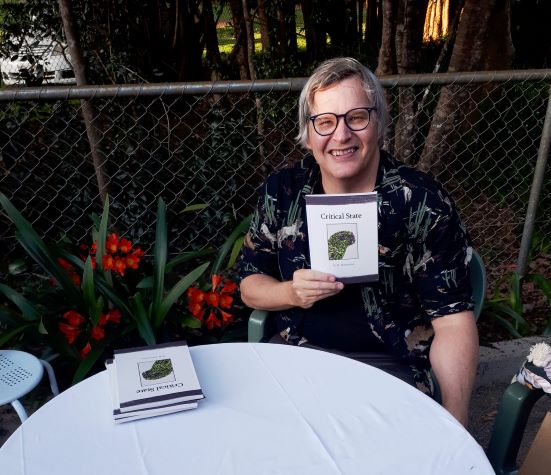
A Critical State
I’d like to first acknowledge the Traditional Owners of the lands on which we gather here today for this happy event. The Wangerriburra clan of the Yugambeh peoples.
I’d like to welcome you here this afternoon to the launch of Critical State, a stunning new collection of poems from B. R Dionysius. I have known Brett for more than a decade and was honoured to be asked to speak about Critical State today.
Brett is one of Queensland’s most accomplished poets and in this, his fifth full book of poems, we are witnessing a poet at his full power and writing the poems that he was perhaps always meant to write.
This is an important book. And it’s a coup for Calanthe Press.
Queensland poetry matters, and the work that Calanthe Press does in showcasing local voices matters. Having stood in this place just over a year ago myself, today’s launch feels almost like a homecoming.
And this book too, feels like home.
In Critical State, Brett’s home state, Queensland is dissected, examined and laid bare.
The mapping of our places and stories feels more important than ever.
Indeed, it feels more critical than ever that Queensland voices are heard.
It feels more critical than ever that our truths are transcribed, spoken and preserved.
It feels more critical than ever that we are honest about who we are, what we have become and what price we have paid along the way.
Brett’s voice is unique and it is uniquely Queensland.
In launching Brett’s Weranga back in 2013 I made comment about its wonderful vignettes of rural Queensland life that could be savoured in the moment and upon re-reading.
In Critical State we find this, and more.
Our state is a quandary – full of contradictions.
It’s baffling, brutal and breathtaking. It’s both fascinating and terrifying.
You will feel all of these things, and more, in Critical State.
This book cleverly maps the ecology of Queensland, from top to tip. But beware, this is not simply a collection of beautiful ecological poems to enjoy with a cup of tea in an afternoon.
You’ll find exceptional beauty in them, but they are poems that will demand more of you. This is a collection of truths, many of them uncomfortable.
This is a book that will cause you to feel and force you to look.
Arranged geographically into five regional sections, Critical State is a culmination of works spanning 2010 to 2021. Prose poems on topical subjects abound and throughout, the underlying theme of resilience and defiance in the face of extinction.
Brett has a masterful ability to write narratives and re-examine histories and, in this book, he layers this with his great passion for ecology, especially birdlife.
This is a tour of Queensland brought to life and with deep engagement with place.
Brett pulls back the rainforest curtains, he lifts up the sticky carpet in a mining town pub, he encourages us into silence and stillness as we observe the interplay between human interventions and the wild.
He shows us the truth that lingers in these places, and more.
You will find moments that delight and abhor you in equal measure in Critical State. It’s a lengthy book – and I have many personal highlights – far too many for a book launch speech.
Critical State opens with poems of the untameable north. In the Wet Tropics, you’ll find sprawling poems that unlock the region’s secrets.
Poems about the degradation of place and of people – interspersed with poems about endangered species.
Poems that pulsate with the sensations of the far north.
In the apocalyptic tale of the Palm Cockatoo the deep north is captured in all of its laconic, watchful glory.
The bird, “tracked through sound, nuts cracking claw to mouth as it ate – and you watched each other for a red hour.”
In Lockhart River – you’re drawn into a landscape where everything is out of place.
In a remote place that should feel unspoiled, the poet finds himself tripping over the detritus of human activity, eerily described in a way that makes you feel like something might happen at any moment.
In Peninsula Development Road, we understand the power in the landscapes of the north and the weakness in what the development-locked south has become.
Two poems flare particularly brightly.
In Unicorns Cross Here, the far north is compelling in its order and chaos: wild, dangerous and unpredictable. Captivating images abound:
- Box jellyfish hanging like toolies
- Birds the colour of a tiramisu cake
- Microbats huddling together like a Scotsman’s sporran or a witch’s pouch bulging with fangs and wings.
- Rainbow lorikeets speaking a language of smashed stones.
But it’s the disturbing description in crocodile paranoia that echoes long after the reading.
A visceral and terrifying sequence as the poet skilfully draws you deeper and deeper into a breathless, uncontrolled moment.
I read poetry for moments just like this.
Critical State is a commentary on us and the places we inhabit and impact, as well as the living things that were here first.
The contrasts of extinction and proliferation are captured perfectly in poems about the cane toad and the cassowary.
The section rounds out with The Wet Tropics – the poem for which the section is named.
In this sprawling poem, we learn more about the poet’s passion for birdwatching. In this work we are brought close to the action by the poet, who invites us to share in his discovery.
“This magical sensation of identifying a new species for the first time, deft as a card trick, as though evolution pulled a bouquet out of its voluminous green sleeve just to make you smile.”
In part two, The Red West, we encounter more poems of survival, defiance and retreat.
In Night Parrots, both extinction and salvation take on a human shape as we watch an ecologist go about his work with this miraculously re-discovered species. The poet musing that:
“For a hundred years, the parrot has drained out between extinction’s fist, an unstoppable slow leak.”
In the poem Spinifex, the plant’s inherent hardiness is a metaphor for the state itself, and described in the poem as being:
“emblazoned on the landscape’s drab uniform like a military patch, like courage, like bravery. Like a Victoria Cross the outback awards itself every day for surviving.”
The poet also brings us a stunning collection of sonnets in the Bimblebox Nature Reserve poems, where creatures are pitted against the mining industry machine.
In this sequence, the tussle between progress and the environment in the Central Queensland region wrestles across the pages.
These are poems of fragility and brutality, stories of the prices we all ultimately end up paying for progress and profit.
In Maureen Cooper’s Quilt, the poet observes:
“Machines dig, machines stitch too; humans applique tininess to the bigger picture. The future wins a raffle.”
And again, in this section, wonderful metaphors on every page:
- Coal deposits forming a “fallow dragon that on awakening will fire up its hot breath.”
- Black throated finches that “scatter to the air like a handful of wedding rice.”
In the Yakka Skink, a tale of defiance, as the tiny creature stands tall before the mining industry – declaring that we were here first and we will endure, long after you retreat from this place:
“we live in your tiny mines that went broke.”
In part three, Wide Bay, the Great Barrier Reef geographically places the reader.
In Asbestos Manor, Hervey Bay the poet paints a coastal town from another era that echoes the region’s endemic environmental sickness. Describing the bright yellow eyesore, heaving with poison as “part protest, part warning, all a mistake.”
These are familiar landscapes for Queenslanders of a certain vintage, and the wonderful Vic Hislop’s Shark Show, provides more of this kitsch cringe.
In this poem, parents walk their kids through an exhibit, that through adult eyes is far less terrifying and far more ridiculous, the prize exhibit, the refrigerated great white observed as:
“wilted like a pressed flower rediscovered after thirty years between the pages of a book.”
And so too are the memories we all carry around with us, and which display the ravages of time when we let them out to inhabit the space.
Having grown up in Toowoomba on the Darling Downs, the next section of the same name felt particularly familiar.
The opening poem Brigalow: An Extinct Pastoral opens the section and in so many ways feels like the heart of this collection.
This poem, which lunges across three pages is spectacular. The poet writes the violent death of the forest with a palpable anger and this poem feels personal.
Stanza after stanza describes the destructive industry of machine and man, likening it to the bringing down of a great Empire. For this was, and still is, a war.
You’re left feeling pain on behalf of the survivors…the images of
- remnant forest ‘begging beside highways’…
- and trunks twisting like the wrenched skin of a Chinese Burn…
- and the countless bodies of endangered species that have gone missing….
Like a bereavement notice in the newspaper, species are named in a roll call of victims, closing out the poem.
Elsewhere in this section another personal highlight, My Brother Finds a Holy Cross Frog in Chinchilla.
A compelling poem about adaptation, set in a soulless FIFO camp.
That something rare and fragile can be found in such surroundings speaks to the critical themes that run through this collection.
The blindness in human intervention, the bright hope of survival and resistance.
In this poem too, a nod to legendary Chinchilla poet Jean Kent.
Critical State concludes in the South East corner, and in this section, poems continue to wrestle with the scars left by big coal and the heavy price of human impact.
This thread is brought to a flash point in the engrossing poem Black Lung.
Here, the poet describes this disease in compelling detail as it inhabits the protagonist’s body that was:
“found in a post-war modern in Bundamba, buried deep in Percy’s body like shrapnel never dug out…”
Throughout, Black Lung disease is likened to a range of natural phenomenon:
- an electrical storm
- a dying universe
- a dark nebula of scarring, and
- a wildfire burning out of control.
In Black Lung, the poet leaves the reader feeling breathless and heavy as the human impact of the mining machine hits close and takes on a human form.
In Failing to See Regent Honeyeaters at Springfield Lakes the poet takes us on an expedition based on a hot tip, as he and his daughter seek out the elusive birds in the great behemoth of the Springfield Lakes development.
In this poem, the poet cleverly balances the possibility of the birds with the artificial nature of the sprawling satellite city.
The birds “shouldn’t have been here at all. In this blighted oasis.”
And – “This wasn’t an ironbark woodland, but renovated park; polished boardwalks, swings, joggers lapping the lake, exercising their knowledge of real estate.”
I think that perhaps this will be the only poem ever written about Springfield Lakes!
The poem concludes with a sense that perhaps all has already been lost and that it is up to us now to rely on our memories and pass on our stories.
I’ve spoken about far too many poems in the book and indeed could have spoken about many more…but I will mention in closing, the final poem in the book Red Shift for Judith Wright.
I spoke earlier about the heart of the book and we find this thematic heart beating here too.
In this poem, we are reminded of how important it is for us as poets, as it was for Judith before us, and for Brett here today to tell these stories, to make noise about them, and to preserve these truths for those who’ll come after us.
And finally, a stanza from Red Shift:
“the Earth sucks in its beltline and gyrates its middle age
spread. Forests recede like hairlines thinning out, as the hand
of progress combs through them. All that’s left is hollow rage
as small groups of creatures turn and make their final stand.”
It’s my great honour to declare Critical State officially launched today!
Again, thank you to Calanthe Press and to Janene and Under the Greenwood Tree bookshop for hosting.
Please buy a copy for yourself and then a copy for your children and your grandchildren.
Our State depends on it.


 Bitter as the cud